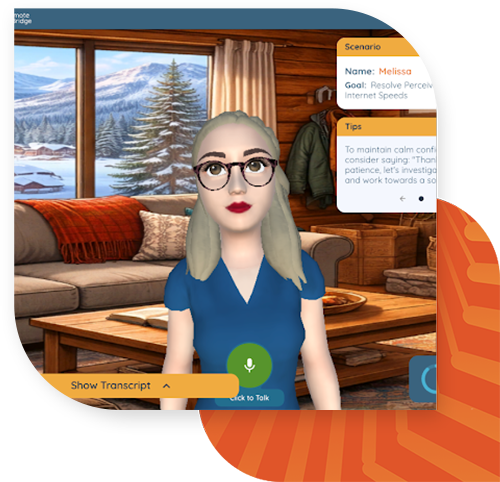
Why AI Role-Play Changes the Relationship Between Training and Assessment
Every time I talk with learning and development leaders about AI-driven role-play simulations, the conversation eventually lands in the same place. ...
I recently attended Customer Connect Expo in Atlanta and had some terrific conversations with people across the customer experience space.
Yes, AI was everywhere. That wasn't surprising.
What caught my attention was how much the conversation has matured.
We're moving beyond Will AI replace jobs? and even beyond How much can we automate? The better question has become: How do we use AI to create a better experience for both our customers and our employees?
Here are my three biggest takeaways.
The conversation has moved well beyond putting a chatbot on a website. Organizations are thinking about the entire customer journey: where AI belongs, where humans belong, and how the handoff between the two should work.
That handoff matters.
AI can provide information, context, and speed. But when a situation requires empathy, judgment, problem-solving, or a difficult conversation, human skills become even more important.
And there is another side to this. If the AI experience is frustrating for the employee, it will eventually become frustrating for the customer.
The goal isn't more automation. It's a better experience.
Another theme was clear: remote and hybrid work aren't disappearing.
Organizations want access to the best talent, regardless of geography. Employees have also developed different expectations about where and how they work.
That changes the job of the manager.
Leading distributed teams requires communication, coaching, feedback, engagement, and accountability in environments where many of the informal interactions of the office no longer happen naturally.
We can't prepare managers for that reality with information alone. Managers need opportunities to practice.
This may have been the most interesting theme of the event.
We can deploy increasingly powerful AI systems, but adoption still depends on whether people are prepared to work with them.
Employees have to learn when to use AI, when not to use it, when to trust an AI-generated answer, when to question it, and how their own role changes when AI becomes part of the workflow.
Those aren't just technology questions.
They're human interaction problems created by technology.
That's why learning needs to provide a safe place to experiment, make mistakes, and build confidence. Simulation, role-play, and gamification can make that practice more approachable and help people develop capability before the moment actually counts.
That was my biggest takeaway from Customer Connect Expo.
AI is changing our technology. It's changing our workflows. But ultimately, it also has to change how people work, communicate, make decisions, and interact with one another.
Technology transformation without human transformation isn't really transformation.
And getting the human side right has implications far beyond AI adoption. When employees are more confident, capable, and prepared to work alongside AI, we can create a better employee experience and, ultimately, a better customer experience.
On Wednesday, October 28 at 12 PM EST, I'll be hosting an upcoming webinar, AI Transformation Is a People Transformation: Preparing Humans for the AI-Enabled Workplace.
We'll dig deeper into the three transformations happening simultaneously — technology, workflow, and human — and discuss what organizations can do to prepare people for what comes next.
I hope you'll join the conversation.
Every time I talk with learning and development leaders about AI-driven role-play simulations, the conversation eventually lands in the same place. ...